

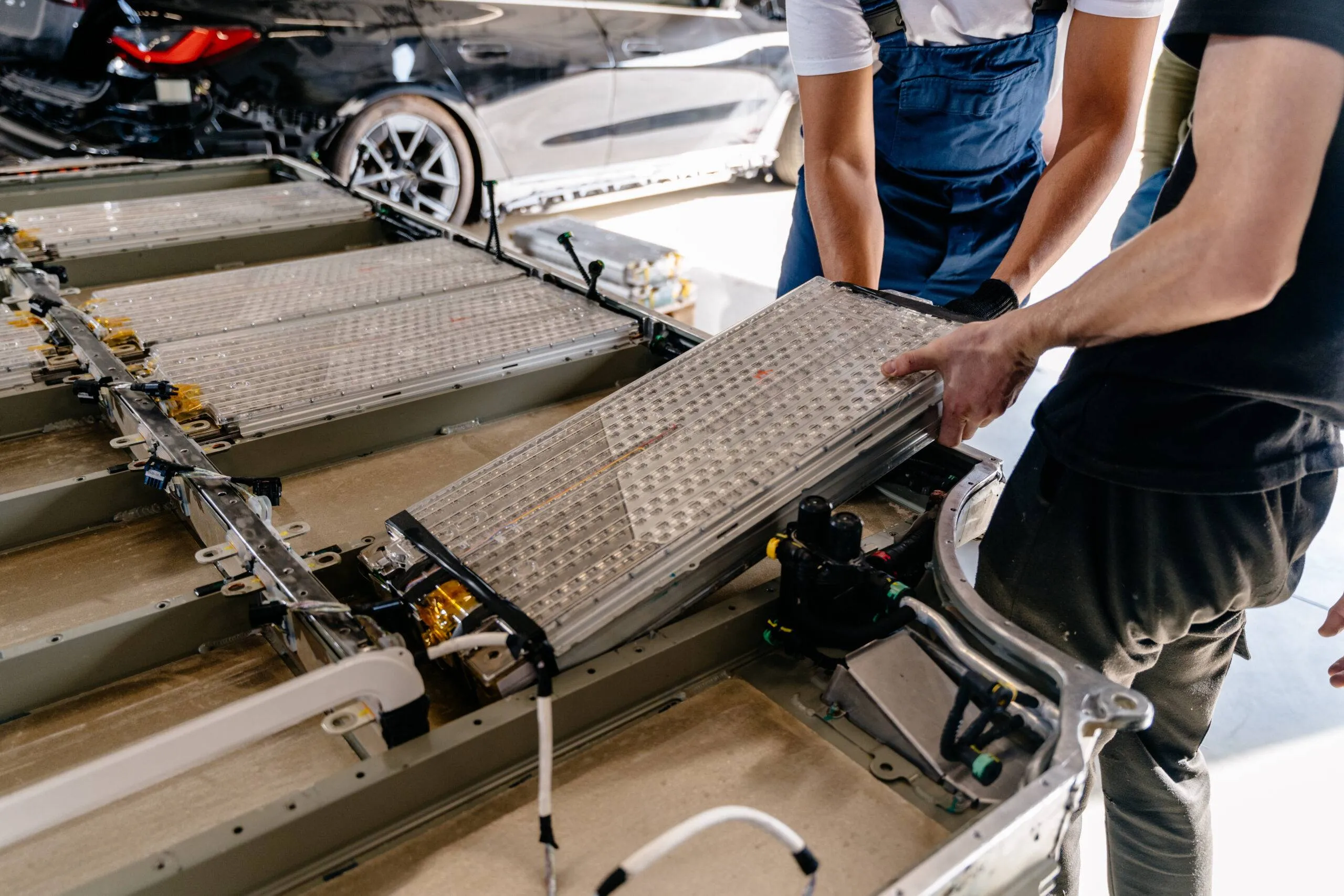
Over the past two decades, batteries have quietly become one of the defining technologies of the global economy. No longer limited to phones and laptops, they now underpin the shift to renewable energy: powering electric vehicles, light means of transport (LMT), and various outdoor power equipment; stabilising city grids and enabling entire energy systems to run on intermittent solar and wind.
And the shift is visible in the numbers: According to the International Energy Agency’s (IEA) latest World Energy Outlook report, by 2035, global EV battery demand is projected to exceed 5 TWh, five times the demand in 2024. For battery energy storage systems (BESS), Bloomberg NEF expects 8 times higher capacity in 2035 (2 TW) compared to 2024. The surprising fact is that battery prices fell by about 75% between 2015 and 2024, making electric vehicles, including LMT, more cost-competitive. Despite the perception of scarcity, prices for critical battery materials such as lithium, nickel, cobalt, and graphite dropped because supply growth outpaced demand. Important drivers here are China’s huge investments in mining and processing, and the rise of the lower-priced lithium iron phosphate (LFP) batteries, another supply chain largely controlled by China.
The regulatory response: The European Union Battery Regulation (EUBR)
The explosive growth in battery demand and the complex, China-dominated supply chain have made it urgent to enact regulatory change. The European Union Battery Regulation (EUBR) is responding to two critical and equally important imperatives:
- To minimise waste and environmental impact from the exponential growth of battery consumption, ensure maximum resource recovery and promote sustainability.
- To secure Europe’s supply chain for batteries, reduce dependency on volatile geopolitical sources for critical raw materials and build up local industry.
While the current political climate might prioritise the security of the supply chain as the most pressing challenge, the good news is that both imperatives share a common solution: recovery of critical materials.
While the Digital Battery Passport (DBP) might be the most talked-about requirement, the EUBR is a holistic piece of legislation covering the entire battery lifecycle, from raw materials to recycling.
What are the four critical pillars of EUBR compliance?
Economic operators must prepare for four critical pillars of compliance, all of which demand unprecedented levels of data management and transparency:
- Carbon Footprint Declaration Requirements
- What it requires: For electric vehicle batteries, rechargeable industrial batteries with a capacity greater than 2 kWh and LMT batteries, the carbon footprint of the battery must be calculated, according to the regulation, Article 7 “as kg of carbon dioxide equivalent per one kWh of the total energy provided by the battery over its expected service life…differentiated according to life cycle stage”. This data will be displayed within the DBP and accompany the battery until this is applied.
- When it applies: Phased implementation with EV batteries first in line, 12 months after the delegated act is public (in draft mode at the time of writing). Rechargeable industrial batteries (except those with exclusively external storage that will come in August 2030, or 18 months after the delegated act) will follow, 18 months after the delegated act, and LMT batteries in August 2028, earliest.
- Supply Chain Due Diligence Policy (SCDDP)
- What it requires: An auditable and comprehensive policy must be implemented addressing social and environmental risks in the sourcing of four key battery raw materials: Cobalt, Natural Graphite, Lithium and Nickel. The due diligence policy is the EUBR’s direct measure to secure an ethical and sustainable supply chain. The entire due diligence system must be reviewed and validated by a qualified, independent third-party auditor (a Notified Body). Note that while the regulation states the requirement applies to economic operators with a global turnover of over 40 million Euros, the new threshold is 150 million Euros.
- When it applies: The Due Diligence Policy was originally scheduled to apply in August 2025. However, in July 2025, the EU officially postponed the application date to allow the industry and regulatory bodies more time to prepare; hence, the new deadline for compliance is August 2027.
- Recycled Content & Recycling Efficiency
- What it requires: Perhaps the most critical area to become more autonomous and build a resilient battery supply chain in Europe is to make sure the supply of secondary raw materials is available and used in new products; hence, this pillar covers two areas:
- The supply side (recyclers): Ambitious targets are set for both recycling efficiency and material recovery targets. The first is concerning the overall mass recovered from the battery, whereas the latter specifies targets for recovery of the critical raw materials (Cobalt, Copper, Lead, Nickel and Lithium).
- The demand side (economic operators): To secure the demand for recycled CRMs, the EUBR specifies mandatory minimum content targets for cobalt, lead, lithium and nickel.
- When it applies: The delegated act establishing the methodology for calculation and verification of rates for recycling efficiency and for measuring the recovery of materials entered into force in July 2025, with requirements starting to apply for recyclers on recycling efficiency end-of 2025, and for material recovery from end-of 2027. For the demand side, requirements to meet target values on recycled content will start to apply from 2031, but disclosure of recycled content is mandatory sooner, with the application of the DBP.
- What it requires: Perhaps the most critical area to become more autonomous and build a resilient battery supply chain in Europe is to make sure the supply of secondary raw materials is available and used in new products; hence, this pillar covers two areas:
- The Digital Battery Passport (DBP)
- What it requires: Three battery classes are subject to DBP: EV, LMT, and industrial batteries > 2kWh. The DBP must not be confused with the general labelling requirement that applies to all batteries, which is a static, model-level information requirement. The DBP serves as the single source of truth for the data required by all three preceding pillars, plus critical performance and lifecycle information. To be able to capture life cycle information, every single battery needs a unique identifier and a digital twin that can hold not only static production information, but also data from the use phase of the battery. Examples of such dynamic, item-level data are State of Health (SoH, or remaining capacity) and State of Charge (SoC); obviously relevant information, e.g. in a second-hand scenario. As such, the DBP will be an important tool not only for market surveillance authorities that oversee compliance and for recyclers, but also for consumers.
- When it applies: February 18, 2027
EUBR compliance timeline: Key milestones
To summarize the requirements for the four pillars, here is a quick look at the major EUBR compliance deadlines:
| EUBR Requirement | Primary Scope | Earliest Compliance/Application Date |
|---|---|---|
| Carbon Footprint Declaration | EV, Industrial (>2kWh), LMT batteries | Starts 12 months after Delegated Act (Phased) |
| Supply Chain Due Diligence Policy | Economic Operators (Turnover > €150M) | August 2027 |
| Recycling Efficiency Targets | Recyclers (Supply Side) | End of 2025 |
| Material Recovery Targets | Recyclers (Supply Side) | End of 2027 |
| Recycled Content Disclosure | Economic Operators (Demand Side) | Mandatory with DBP application |
| Mandatory Recycled Content Targets | Economic Operators (Demand Side) | Start from 2031 |
| EU Registry Integration | All Operators | July 19, 2026 |
| Digital Battery Passport (DBP) Mandate | EV, LMT, Industrial (>2kWh) batteries | February 18, 2027 |
EUBR compliance checklist: Next steps
EUBR is aiming to take Europe towards a more secure, circular and transparent industry. The number of delegated acts (32) and implementing acts (15) mentioned in the regulation is illustrative of how comprehensive this is. With our four pillars above, and the data requirements for the DBP, it is easy to get discouraged.
If you haven’t already started, at Kezzler, we strongly recommend starting piloting on DBP as soon as possible. Although we’re still waiting for the final details, we know more than enough for companies to start preparing.
- Start DBP piloting now: We are currently involved in such DBP pilot projects, and it feels very timely to ensure processes, organisation and IT are all ready for compliance well ahead of the February 18th, 2027, deadline.
- Unlock business value: It also creates confidence in the client organisation when they see that this is doable. Control and compliance confidence also allows for creative thinking outside the compliance field: Where can we unlock business value? For forward-looking companies, the Digital Battery Passport is not an expense, but a prerequisite for unlocking high-value business opportunities like second-life use cases, and circular business models.
- Prepare for registry integration: By July 19th, 2026, we should be able to integrate with the EU Registry and register the first DBPs.
- Future-proof your platform: This is exciting not only from a DBP perspective, but also for the rest of the product categories subject to Digital Product Passports through the Ecodesign for Sustainable Products Regulation (ESPR). It is the first part of the central DPP system managed by the EU, and it might provide a glimpse into detailed requirements also for other sectors, such as Textile, Tyres, Furniture, Iron & Steel and Aluminium. And regardless of sector, remember that you only need one digitisation & traceability platform.