



The EU battery regulation’s digital battery passport is one of the most ambitious product-data initiatives the EU has ever attempted. From February 2027, every EV, LMT and industrial battery above 2 kWh placed on the EU market must carry one. With less than eight months to go, the EC is working hard to fill the information gaps. Progress on identifying the responsible economic operator helps, though these questions feel overdue. How the battery passport handles dynamic data is another much-debated topic, specifically how often it must be updated and how to manage it for batteries never designed to generate or share such information.
KEY TAKEAWAYS
- Dynamic data is one of the least-defined parts of the Digital Battery Passport.
- Industrial batteries without a connected battery management system (BMS) do not need to publish dynamic data.
- Batteries with a connected BMS must share dynamic data. Update frequency is the operator’s call, with status changes as the confirmed minimum.
- Manufacturers should begin implementing well-defined battery passport requirements now while preparing for future guidance.
What unresolved questions still face the battery industry?
The industry is currently grappling with defining the precise point in the supply chain at which a battery passport becomes legally mandatory. The Commission’s DG GROW webinar on 27 May 2026 addressed some of these but also revealed there are still unresolved questions.
The Commission introduced the term “fully functional and operational” as the state when a battery becomes a battery subject to battery passport. What this means in practice in every situation is not clear, and it is difficult to come up with an unambiguous definition that covers every conceivable scenario in vastly diverse and complex supply chains.
These are not academic concerns. They are the kind of practical, operational questions that manufacturers, importers, and systems integrators need answered before they can invest confidently in compliance infrastructure. Let us assume they will be resolved. They must be, if the February 2027 deadline is to hold. That allows us to turn to what may be the hardest technical challenge in the entire framework: dynamic data.
What are the EUBR dynamic data requirements?
Annex XIII Paragraph 4(d) of the regulation mandates that a battery passport must contain live data tracking the battery’s real-world usage, environmental conditions, and state of health. This requires the passport to include:
“information and data resulting from its use, including the number of charging and discharging cycles and negative events, such as accidents, as well as periodically recorded information on the operating environmental conditions, including temperature, and on the state of charge.”
The BatteryPass Project’s attribute list is now standardised under DIN DKE SPEC 99100, the official standard for battery passport data requirements. It specifies 5–16 dynamic attributes, with all 16 required for stationary industrial batteries above 2 kWh. This is not a one-time snapshot. It is a living data record that must stay current for the battery’s entire lifespan.
These requirements make intuitive sense for EV batteries with a natural second life. They are far less obvious for the diverse industrial >2 kWh category. Many industrial batteries are stationary, single-owner assets that operate on one site for decades. A telecom backup battery, for example, has no secondary market and no consumer interaction. And while all batteries eventually reach a recycler, the data needed at end-of-life differs significantly from continuous operational tracking. This raises two practical questions:
- How often must dynamic data be updated?
- What if the battery doesn’t have a connected BMS?
Is a Battery Management System (BMS) mandatory across all battery types?
While a battery management system (BMS) is the primary tool used to generate usage tracking metrics, the EU regulation does not actually mandate a BMS for every battery category.
The regulation defines the BMS as “an electronic device that controls or manages the electrical and thermal functions of a battery in order to ensure the battery’s safety, performance and service life.” The BMS continuously measures cell voltages, temperatures, current flows, and cycle counts. It calculates state of charge. It logs thermal events. In lithium-ion batteries, the chemistry that dominates EV and many modern industrial applications, a BMS is not optional. It is essential for safety. A connected BMS goes one step further: it transmits these live metrics to a cloud network for sharing with the battery passport.
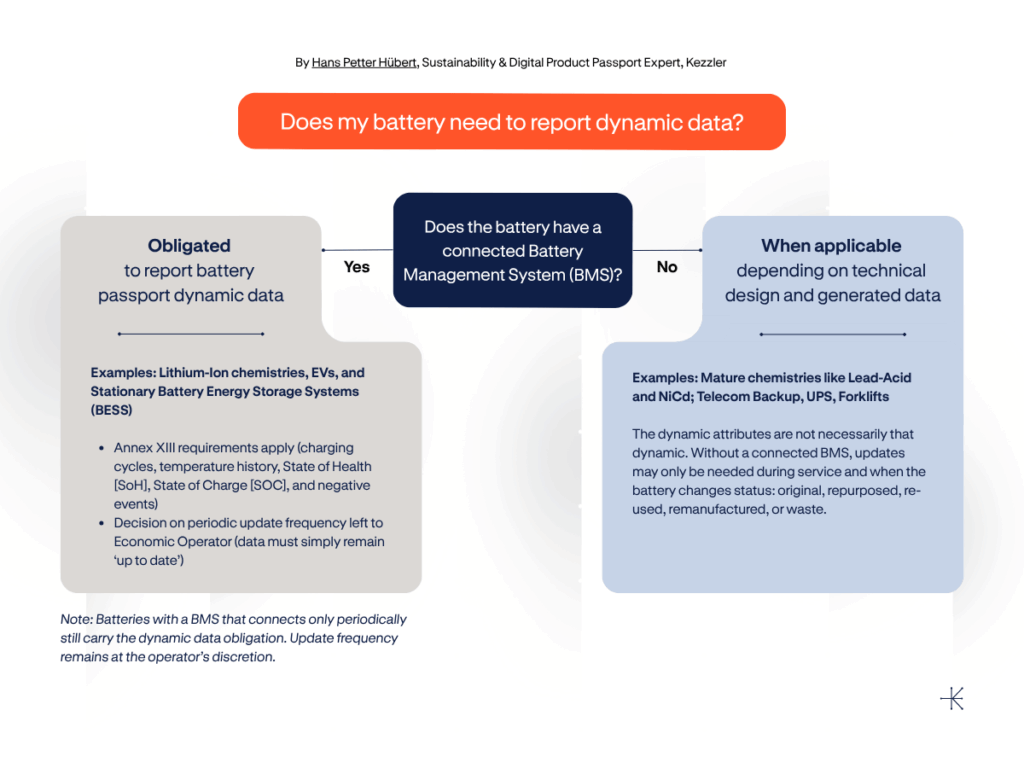
But as many have discovered, while the regulation requires dynamic data, it does not require all batteries to have a connected BMS. Article 14(1), which specifically mandates that BMS systems contain up-to-date state-of-health data, applies only to stationary battery energy storage systems, LMT batteries, and EV batteries. It presupposes the existence of a BMS in those categories but does not impose a general BMS installation obligation across all battery types.
Do industrial battery passports require dynamic data without a connected BMS?
Industrial batteries that operate safely without a BMS carry no obligation to report or update dynamic usage data in their passport. This brings relief to an extraordinarily diverse category: telecom backup systems, UPS units, forklift traction batteries, railway signaling, and garden equipment batteries. Thousands of applications across dozens of sectors fall here.
This issue previously caused massive industry uncertainty. EUROBAT, the European industrial and automotive battery manufacturers’ association, argued in a December 2025 position paper that the regulation’s technology-neutral approach creates an implicit exemption:
“Industrial batteries based on those chemistries that do not require a BMS (e.g. lead-based or nickel-cadmium) are therefore exempt from the obligation to update data resulting from battery use… Batteries that technologically do not require a BMS cannot generate data resulting from battery use in a technical sense. The Regulation implicitly acknowledges this reality by not imposing a general BMS requirement across all battery categories.”
Batteries without a connected BMS, across both industrial and LMT categories, are not required to report dynamic data attributes that are not technically applicable to their configuration. This is confirmed through EC webinar guidance and the published attribute list. This is a welcome resolution as it aligns the obligation with technical reality and avoids forcing BMS integration onto mature chemistries.
The remaining challenge: BMS-equipped batteries and update frequency
For batteries with a battery management system, the regulation leaves update frequency to the economic operator’s discretion. The only condition is that data remains “up to date.”
In theory, a cloud-connected BMS timestamps every measurement and links it to a specific battery serial number. A traceability platform like Kezzler’s could store and manage that data. But this is connectivity infrastructure industrial installations simply do not have and may not want. Even if they did, no guidance specifies the expected frequency. The regulation only states that data should be captured “periodically” and remain “up to date.” And as EUROBAT warns, mandatory continuous or real-time data transmission would increase cost, energy consumption, and cybersecurity vulnerability. The regulation leaves this decision with the responsible economic operator. Each operator must judge what update frequency keeps data sufficiently “up to date.”
For now, companies must assess the right update frequency case by case, guided by the purpose the data serves.
How should operators build a strategy against a moving target?
The most practical path is to build compliance systems around clearly defined static parameters. Start now, rather than waiting for dynamic data rules to settle.
The DPP Registry opens for testing (without APIs) on 19 July 2026. Additional functionality will roll out throughout the year. With the Registry, the Commission has indicated it will publish a semantic rulebook to make Annex XIII interpretation more consistent.
The Commission’s July 2026 webinar established one firm baseline: update whenever the battery changes status — specifically to ‘original,’ ‘repurposed,’ ‘re-used,’ ‘remanufactured,’ or ‘waste.’ Beyond that, operators must assess what update frequency the purpose of their data requires.
A pragmatic path through an unfinished framework
The picture can feel overwhelming. Foundational definitions are still being refined. Dynamic data obligations and update frequencies are undefined. Implementing acts (on legitimate-interest access) not yet adopted. A registry not yet live. All against a hard deadline less than eight months away. No wonder some responsible economic operators feel they must build compliance systems against a target that is still moving.
At the same time, it is easy to understand the Commission’s desire to hold the line on deadlines for the first product category subject to the digital product passport. But rather than waiting for every question to be unambiguously answered, there is a more pragmatic alternative: Start with what is clearly defined and build from there.
The basics of the digital battery passport are well-established. Unique identifiers. QR codes. Static master data, chemistry, capacity, manufacturer identity, conformity declarations. Could the alternative be to start with what is well-defined, allowing both the industry and the regulator time to align on the remaining parts? There are already important requirements that will be included later, and the first version of the battery passport will not be perfect from day one.
But if the industry must implement requirements the regulation has not clearly defined, we risk a much worse start for the digital product passport. Ultimately, a thin but well-defined battery passport in February beats a comprehensive but ill-defined one that no one can actually comply with.